
Choosing an Arcade Motherboard Manufacturer: Compatibility, MOQs, and Support
Author
Date Published
Reading Time
The lowest motherboard quote can become the more expensive purchase once interface adapters, software licensing, cabinet modifications, and replacement delays enter the calculation. A useful comparison starts with the cost of a working, serviceable installation: the board, everything required to integrate it, and the support needed to keep the machine earning revenue.
When choosing an arcade motherboard manufacturer, establish three things before negotiating volume pricing: whether the exact hardware revision works with the intended cabinet and game software, what order quantities apply to each configuration, and how faults and replacements will be handled. These conditions determine whether an attractive unit price survives installation and daily operation.
Define what the motherboard quotation actually includes
“Arcade motherboard” can describe a game board with integrated inputs and outputs, an industrial computer running separate game software, or a processor board connected to a dedicated control board. Two quotations using the same product description can therefore cover substantially different assemblies.
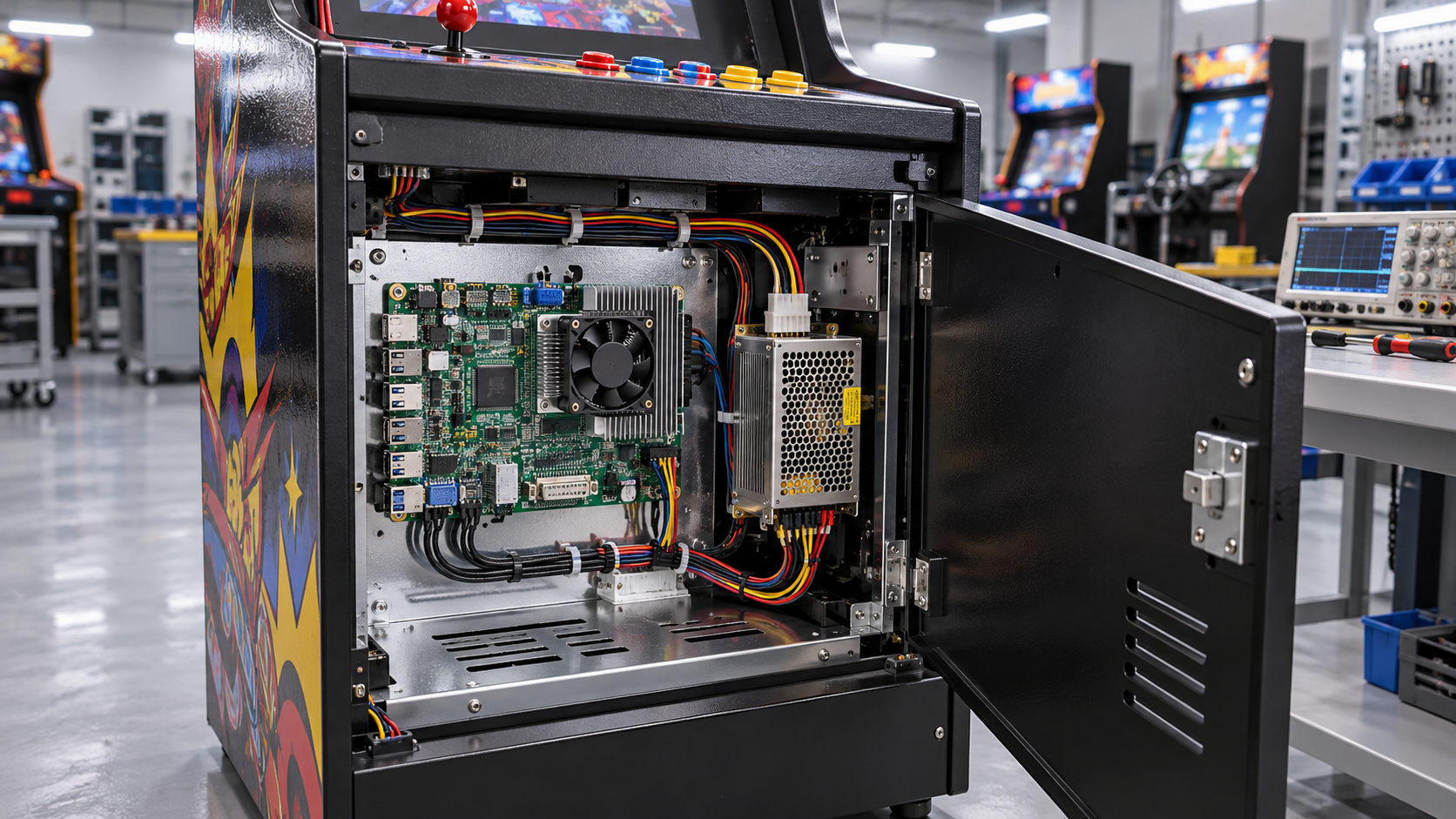
Request a configuration breakdown that identifies the processor board, memory, storage, cooling assembly, input/output hardware, power requirements, and software entitlement. Record the board revision and firmware version alongside the model number. A shared model name does not establish that connectors, component selections, or software images remain identical across production batches.
Separate physical hardware from the right to run the game. Clarify whether the quoted package includes a licensed game image, operating system, activation device, recovery files, and any recurring fees. Software tied to a storage device, security dongle, or motherboard identifier needs an explicit replacement procedure. Otherwise, an electrically compatible spare board could remain unusable while activation is unresolved.
Compatibility must be demonstrated at the cabinet
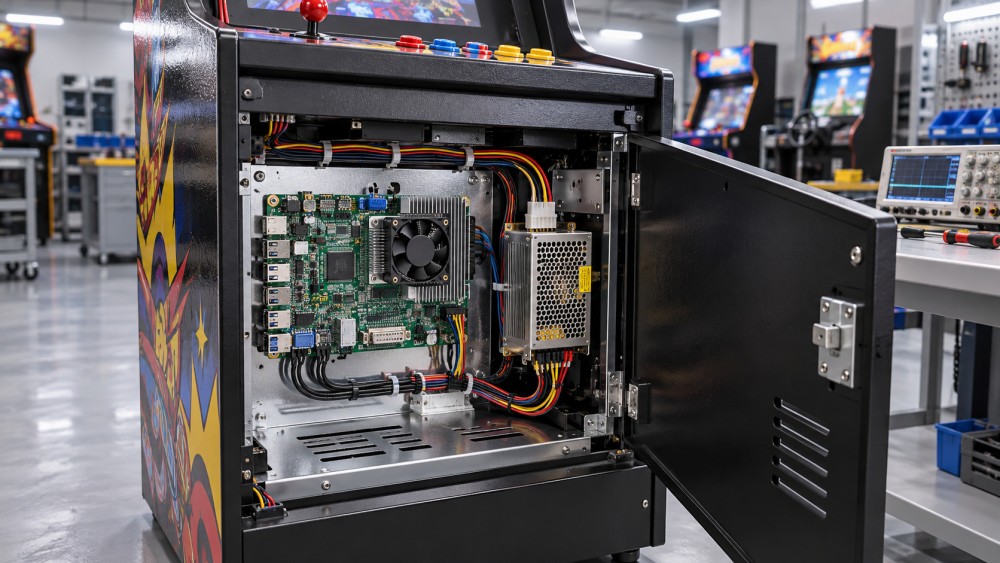
A matching connector is only the beginning. Pin assignments, signal voltage, output capacity, and communication behavior must agree with the cabinet wiring and connected devices. Treat compatibility as a documented relationship between a specific board configuration and a specific machine configuration.
Power, wiring, and physical fit
Compare the supply requirements against the installed power supply, including available current, startup demand, connector ratings, and grounding arrangements. Measure voltage at the board under representative load. A supply that appears satisfactory with the cabinet idle can behave differently when lighting, sound, or mechanical devices operate.
A harness described as JAMMA-compatible still requires a pin-by-pin comparison, particularly where additional buttons, stereo audio, or auxiliary functions use extensions or modified assignments. For boards using a separate input/output interface, confirm the interface revision and communication method. Never infer electrical compatibility from connector shape or wire color.
Cabinet fit also includes mounting positions, component height, cable clearance, and airflow. An open-bench demonstration does not establish thermal performance inside a closed enclosure. The sample should run with the intended mounting orientation, filters, fans, and nearby heat sources present.
Game behavior and peripheral integration
Display compatibility includes resolution, refresh rate, orientation, and the output available during startup and recovery. A game that displays correctly after loading can still leave a maintenance screen inaccessible through the installed monitor or converter.
Map every control and peripheral to its interface and expected behavior. Coin inputs, service buttons, card readers, ticket dispensers, touchscreens, steering controls, and force-feedback devices introduce different requirements. A USB connection alone does not establish driver support or command compatibility. Obtain the supported device models, protocol details where available, and required firmware versions.
Payment and payout behavior deserve transaction-level testing. Confirm how credits are recorded, what happens when communication drops, and whether interrupted payouts remain pending after restart. The game application, control board, and payment system each influence these outcomes; a motherboard replacement does not automatically preserve them.
Use the sample order to establish a production reference
A sample is valuable when it represents what will arrive in the production order. Establish whether it uses production components, release firmware, and the same storage image planned for shipment. A development board with manually adjusted settings provides weak evidence for repeatable installation.
Agree on acceptance criteria before the sample ships. Include startup, extended operation inside the cabinet, peripheral transactions, network interruption where relevant, and recovery after power loss. Exercise service menus and configuration retention as well as gameplay. Conduct interruption tests in a controlled setup that protects connected mechanisms and transaction records.
When a sample passes, retain its configuration record: board revision, firmware, software image identifier, peripheral versions, wiring changes, and settings. This becomes the reference for subsequent deliveries. Without it, diagnosing a later failure becomes an argument over whether the cabinet, software, or supplied board changed.
Sample terms should also address ownership, return eligibility, shipping responsibility, and whether any sample payment is credited against a later order. Clarify who funds integration changes if a claimed compatibility feature fails the agreed test.
MOQ terms can change with configuration and delivery timing
The published minimum order quantity rarely answers every ordering question. Ask whether the MOQ applies to the overall purchase, each board model, each memory and storage configuration, or each customized firmware image. An order that meets the total quantity can still fall below the minimum for individual variants.
Distinguish stock hardware from customization. Connector changes, special firmware, custom startup screens, and dedicated peripheral support can introduce engineering charges or separate minimums. Request separate pricing for development, validation, production units, and future repeat orders. This reveals whether an apparently expensive first batch includes work that will not recur.
Volume commitments and shipment quantities also need separate terms. A scheduled order with staged deliveries can reduce storage and cash tied up in stock, but only if release dates, cancellation obligations, and configuration changes are defined. Confirm whether undelivered units remain committed after the cabinet design changes.
Obtain lead times for samples, initial production, repeat orders, and service replacements separately. A short production lead time offers little protection if replacement units require a fresh manufacturing run. Ask when the lead-time clock starts and which approvals, deposits, or software releases must be complete first.
Compare cost per accepted installation
Normalize quotations to the same working configuration. Add mandatory accessories, interface boards, harness changes, storage, cooling, software activation, freight, applicable import charges, and installation work. Keep one-time engineering costs visible instead of hiding them inside the unit price.
Cost per accepted installation = total acquisition and integration cost ÷ installations that meet the agreed acceptance criteria.
This calculation exposes a common pricing distortion: a cheaper board requiring cabinet rework can cost more to deploy than a higher-priced assembly that fits the existing installation. It also prevents sample discounts or incomplete packages from distorting the production comparison.
Evaluate operating exposure separately using actual venue records where available. Relevant inputs include service labor, replacement shipping, swap time, spare inventory, and contribution lost during downtime. Avoid assigning a precise lifetime saving when failure rates and repair turnaround remain unverified. Compare scenarios instead: an immediate spare-board swap, a return-and-repair cycle, and a replacement delayed by unavailable stock.
A specification advantage has value only when it supports the game workload or service plan. Additional processing capacity does not resolve unsupported drivers, poor cooling, or a license that cannot transfer to a replacement board.
Technical support needs a defined route to resolution
“Technical support included” leaves the most expensive questions unanswered. Establish the contact channel, working hours, escalation route, and whether application or firmware engineers participate when the first response cannot resolve a fault. Distinguish an initial response commitment from a repair or replacement commitment.
Request a sample troubleshooting procedure. Useful support documentation identifies status indicators, accessible logs, recovery methods, and tests that isolate the processor board from the power supply, storage, harness, and peripheral interface. Generic instructions to reinstall software provide little help when a fault occurs only during payout or after the cabinet warms up.
Remote access requires practical limits: authorization for each session, a record of configuration changes, and a way to restore the previous state. Where support requires an internet connection, establish how diagnosis proceeds at sites with restricted connectivity.
Firmware updates and recovery access
Define how updates are delivered, which board revisions they support, and whether release notes describe affected peripherals and configuration changes. An update intended to fix one device can alter timing or settings elsewhere in the machine. Validate it on a representative cabinet before wider deployment.
Recovery access matters just as much as update access. Obtain the permitted recovery image, installation instructions, required activation steps, and rollback conditions. Confirm whether access continues after the warranty expires and whether recovery depends on a supplier-controlled server. A stored image has limited service value if restoring it requires credentials or licensing assistance that is unavailable.
Warranty and replacement terms should support an actual board swap
Read the warranty alongside the return procedure. Clarify when coverage begins, how arrival damage and early failures are handled, which conditions are excluded, and who pays shipping in each direction. Identify whether repair time begins at fault approval or only after the returned board reaches the service facility.
Advance replacement, return-and-repair, and local spare stock produce different downtime outcomes. Establish which options are available and whether replacement units arrive configured, activated, and ready for the documented cabinet setup. Include the treatment of stored settings and transaction data where these reside on the replaced hardware.
Long-term availability also requires specifics. Ask how component substitutions are announced, whether revisions require revalidation, and what notice precedes discontinuation. “Equivalent replacement” should have a defined meaning covering fit, interfaces, software support, and licensing. Similar processor performance alone does not establish interchangeability.
The purchase specification should attach the approved configuration, acceptance criteria, permitted substitutions, order-release terms, and service obligations to the commercial quotation. A lower price is defensible when these conditions are satisfied; unresolved compatibility or replacement terms belong in the cost comparison before the order is placed.
Related News
 Illuminated ShuffleboardsHow Cloud-Controlled Arcades Manage Games Across Multiple LocationsDiscover how networked cloud-controlled arcades manage games across locations, streamline fault response, compare performance, and coordinate remote updates.
 Multiplayer VR Free-RoamIAAPA Announces 2026 Expo Media Lineup Featuring Immersive Experiences and Arcade GamesExplore the 2026 IAAPA Expo media lineup in Orlando, featuring immersive experiences, arcade games, new attractions and industry collaborations.
 FEC Capital & Yield per Sq.FtCommercial VR Entertainment for FECs: Startup Costs and Break-EvenPlan commercial VR entertainment for your FEC with a clear view of startup costs, operating break-even, and investment payback. Explore what to budget before you buy.
 FEC Capital & Yield per Sq.FtAmusement Equipment Lifecycle Planning: How to Budget for Repairs and ReplacementExplore amusement equipment lifecycle planning to budget for repairs, reduce downtime, and time replacements. Discover practical ways to protect cash flow and keep your venue earning.
 Multiplayer VR Free-RoamZero Latency VR in the USA: What to Check Before Booking a SessionPlanning zero-latency gaming USA? Check age limits, headset fit, group privacy, session time, and total costs before booking. Read the guide to choose the right VR session for your group.
 FEC Capital & Yield per Sq.FtLaunch Entertainment Opens 31,400-Square-Foot FEC in PensacolaLaunch Entertainment opens a 31,400-square-foot FEC in Pensacola. Discover duckpin bowling, trampolines, interactive play and more—all designed for family fun.
 Spatial Computing & 6-DOFMarkerless Motion Capture Technology: How It Works and What Affects AccuracyExplore markerless motion capture technology: how it works, what affects accuracy, and how to test cameras, latency, and tracking reliability before choosing your system.
 FEC Capital & Yield per Sq.FtArcade Machine Technology Trends: Impacts on FEC Costs and RevenueExplore arcade machine technology trends shaping FEC costs and revenue. Compare cashless systems, connected games, and VR to uncover smarter investments and improve profitability.
 Illuminated ShuffleboardsChoosing an Arcade Motherboard Manufacturer: Compatibility, MOQs, and SupportChoosing an arcade machine motherboards manufacturer? Compare compatibility, MOQs, and support to avoid hidden costs and downtime. Learn what to verify before placing your order.
 IoT Crane Claw MachinesJapan’s Claw Machines Turn to Everyday Essentials, Offering Eggs and Toilet PaperJapan’s claw machines are swapping toys for eggs, rice and toilet paper amid inflation. Discover how everyday essentials are reshaping arcade prizes and operators’ business strategies.
 FEC Capital & Yield per Sq.FtChoosing FEC Software for Arcades: Integration, Reporting, and Total CostCompare fec software for arcades by integration, reporting, and total cost. Discover what to test, uncover hidden fees, and choose a platform that keeps guests playing.
 FEC Capital & Yield per Sq.FtLelantos Reports $8.795 Million in Airtopia Sales and Revenue Through SeptemberLelantos reports $8.795 million in Airtopia sales and revenue through September, up 11.8%. Explore how new parks drove growth and what the figures mean for FEC operators.
 FEC Capital & Yield per Sq.FtChoosing a Networked Amusement Systems Supplier: Upfront and Ongoing CostsChoosing a networked amusement systems supplier? Compare upfront costs, software fees, payment charges, and support to uncover hidden expenses and secure better long-term value.
 FEC Capital & Yield per Sq.FtInaugural African Amusement and Attractions Expo AAAEXPO 2026 Opens in RabatAAAEXPO 2026 brings amusement equipment, VR and attractions suppliers to Rabat, October 21–23. Explore Africa’s inaugural expo and key procurement insights for your next project.
 FEC Capital & Yield per Sq.FtCashless Arcade Business Models: Pay-per-Play vs. Unlimited-Play PricingCompare cashless arcade business models: pay-per-play, unlimited-play, and hybrid pricing. Discover how to protect margins, manage capacity, and keep guests coming back.
 Multiplayer VR Free-RoamCounty Culture and Tourism Bureau Tenders VR Walking Platforms, Headsets and Other EquipmentVR walking platforms and headsets feature in a county culture and tourism bureau tender. Explore the equipment scope and key bidding considerations for suppliers and integrators.
 FEC Capital & Yield per Sq.FtCommercial Fun Center Systems: How to Evaluate Cost and Revenue per Square FootCompare commercial fun center systems by ownership cost, revenue per square foot, and realistic returns. Discover how to choose equipment that earns its space and protects your investment.
 Multiplayer VR Free-RoamSandbox VR Miami Adds Squid Game and Stranger Things Free-Roam ExperiencesExplore Sandbox VR Miami’s Squid Game and Stranger Things free-roam experiences in Wynwood, with full-body tracking and multiplayer interaction. Discover a new way to enter familiar worlds.
 CE/FCC & IoT Data SecurityHow Arcade Anti-Cheat Systems Detect Ticket Fraud and Machine TamperingDiscover how arcade anti-cheat systems detect ticket fraud and machine tampering using payout checks, sensors, and audit trails. Learn to protect revenue without disrupting legitimate play.
 FEC Capital & Yield per Sq.FtEntertainment Technology Export Trends: Where FEC Equipment Demand Is GrowingExplore entertainment technology export trends to uncover promising FEC equipment markets, assess buyer demand, and target opportunities with viable economics and reliable local support.
 Global Network DartboardsNetworked Pub Games for Bars: Comparing Space, Fees, and League FeaturesCompare networked pub games for bars by space, recurring fees, and league features. Explore darts, pool, and trivia to find the right fit and keep players coming back.
 FEC Capital & Yield per Sq.FtComparing Commercial Arcade Equipment Suppliers: Upfront vs. Lifetime CostsCompare commercial arcade equipment supplier quotes beyond upfront prices. Discover lifetime costs, warranty gaps, and downtime risks to choose a supplier that protects your profits.
 Global Network DartboardsChoosing a Dartboard Camera Scoring Supplier: Accuracy, Integration, and SupportChoose a camera scoring supplier with confidence. Learn how to verify dartboard accuracy, streamline integration, assess support, and compare costs before you commit.
 Spatial Computing & 6-DOFChoosing a Motion Simulator for an Entertainment Center: Space and ThroughputChoosing a motion simulator for entertainment center operations? Learn how to compare installed space, boarding cycles, and sustained throughput to maximize floor value and avoid costly bottlenecks.
 FEC Capital & Yield per Sq.FtGlobal Digital Entertainment Trends: Where Should FEC Operators Invest?Explore global digital entertainment trends to guide FEC investment in connected operations, social games, and VR. Discover how to drive repeat visits and improve returns.
 FEC Capital & Yield per Sq.FtAmusement Equipment Maintenance Planning: Build a Downtime-Reducing ScheduleAmusement equipment maintenance planning helps venues cut downtime, protect revenue, prioritize critical assets, and build reliable service schedules.
 FEC Capital & Yield per Sq.FtSmart Venue Solutions: How to Connect Attractions, AV, and OperationsSmart venue solutions connect attractions, AV, payments, and operations to improve guest flow, reliability, maintenance, and revenue performance.
 FEC Capital & Yield per Sq.FtWhere Is Esports Entertainment Creating New Revenue Opportunities for FEC Operators?Esports entertainment creates new revenue opportunities for FEC operators through racing, VR, digital sports, arcade competition, leagues, events, and longer guest visits.
 FEC Capital & Yield per Sq.FtWhen Should an FEC Franchise Hire an Operations Consultant to Improve Margins?FEC franchise operations consultant: learn when margin pressure, downtime, labor costs, and uneven guest experiences call for expert action to improve profitability.
 FEC Capital & Yield per Sq.FtWhich Smart Arcade Technologies Increase Revenue per Square Foot for FEC Operators?Smart arcade technology for operators can raise FEC revenue per square foot through cashless payments, IoT uptime monitoring, prize controls, and high-throughput immersive attractions.
Related News
- 00
0000-00
How Cloud-Controlled Arcades Manage Games Across Multiple Locations - 00
0000-00
IAAPA Announces 2026 Expo Media Lineup Featuring Immersive Experiences and Arcade Games - 00
0000-00
Commercial VR Entertainment for FECs: Startup Costs and Break-Even - 00
0000-00
Amusement Equipment Lifecycle Planning: How to Budget for Repairs and Replacement - 00
0000-00
Zero Latency VR in the USA: What to Check Before Booking a Session
Indoor Recreation Scientist
Strategic Intelligence Center